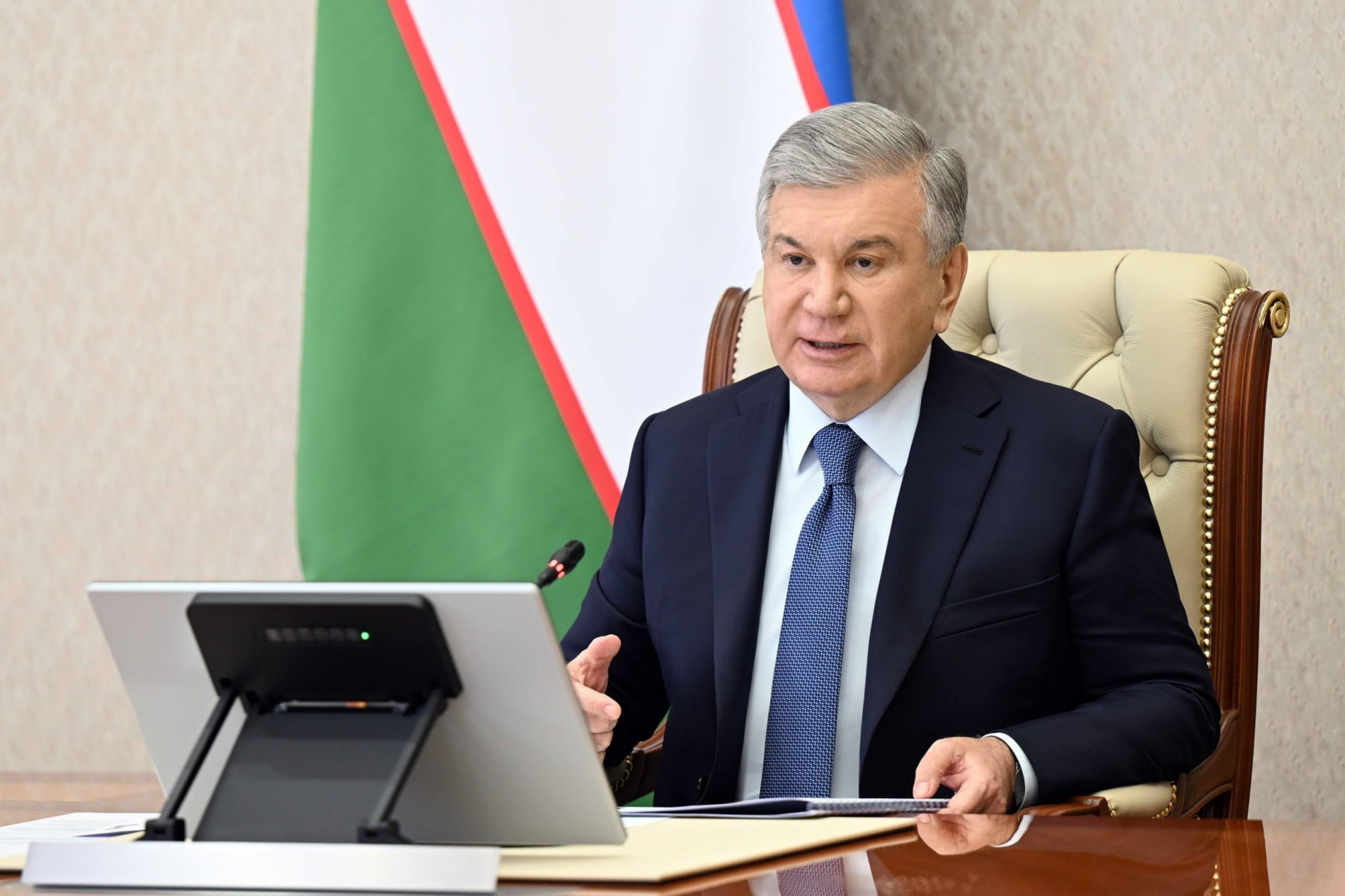
On December 26, President of the Republic of Uzbekistan Shavkat Mirziyoyev gave an Address to the Oliy Majlis and the people of Uzbekistan.
- Over the past nine years, together with you and our people, we have gone through a significant path of development. Our economy has acquired the new quality, we have expanded market relations and social protection, and strengthened the rule of law. Most importantly, the results of our reforms are felt in every mahalla, every family, and by every individual in their daily lives, - said the Head of State in the beginning of his speech.
Regardless of how difficult the circumstances were, democratic reforms have been consistently continued. Thanks to the support of the people and enthusiasm of our youth, changes in people’s mindset and worldview, a more cohesive society, the initiative and dedicated work of entrepreneurs, workers, and farmers, as well as a friendly foreign policy based on mutually beneficial cooperation, significant achievements have been made in all spheres in 2025.
For the first time in the country’s history, gross domestic product exceeded $145 billion. It was noted that exports increased by 23 percent, reaching $33.4 billion. It was especially emphasized that the gold reserves exceeded $60 billion for the first time.
The volume of foreign investment attracted into the economy reached $43.1 billion, with the share of total investment in GDP at 31.9 percent. Leading international rating agencies raised the country’s sovereign rating from BB– to BB.
Due to fundamental changes in the energy sector, the electricity production was raised to 85 billion kilowatt-hours.
This year, clean drinking water reached the homes of 715,000 residents in 188 mahallas for the first time, and water supply was improved for another 2.3 million people.
This year, 5 million people have started to receive sustainable income, and the unemployment rate has decreased from 5.5% to 4.9%. About 1,5 million people in need have been lifted out of poverty, and for the first time, 1,435 mahallas became poverty-free areas.
168 thousand children from low-income families were admitted to state kindergartens on a preferential basis. Starting this year, an inclusive education system was implemented in 208 kindergartens for the first time.
The poverty rate in the country has decreased from 8.9% at the beginning of the year to 5.8%.
- When we started this work, one-third of our population lived below the poverty line. Thanks to the implementation of a completely new social protection system, providing over 100 types of services – such as loans, subsidies, and compensations – delivered through the “seven” in mahallas, more than 8,5 million people have risen out of poverty, and unemployment has been reduced by half.
As a result, this year we achieved the target set three years ago to halve poverty by the end of 2026, - stated the President.
It was noted that the talented youth contributes greatly to the development of New Uzbekistan through major successes in education, science, culture, arts, sport and other spheres.
In the past years, the country has increasingly become an international dialogue platform for discussing global issues. In particular, this year Uzbekistan hosted the 150th anniversary Assembly of the Inter-Parliamentary Union, session of the UNESCO General Conference, the Central Asia – European Union Summit and the International Climate Forum.
It was also noted, that at the meeting of the leaders of Uzbekistan, Tajikistan, and Kyrgyzstan held in March in Khujand, a historic agreement on the junction point of the three countries’ borders was signed for the first time in history, and a “Declaration of Eternal Friendship” was adopted.
At the recently held Consultative meeting of the Heads of State in Tashkent, an idea on the creation of a strategic format for the Central Asian Community to elevate integration processes to a new qualitative level, was proposed. The decision to admit Azerbaijan as a full member of the Central Asian format is of historic significance.
According to the President, this step will undoubtedly strengthen strategic connectivity and stability between Central Asia and the South Caucasus.
In October, an Agreement on Enhanced Partnership and Cooperation between Uzbekistan and the European Union was signed in Brussels. The Central Asia – U.S. Summit held in November contributed to elevating multilateral and long-term partnerships to a fundamentally new level. Last week, at the meeting of the leaders “Central Asia – Japan” in Tokyo, important agreements were reached in the fields of education, healthcare, digital technologies, infrastructure, and industry.
Earlier this week, in Saint Petersburg, a meeting was held with the heads of the Commonwealth of Independent States, which also outlined new directions for our cooperation.
- All of this is taking our international relations to a fundamentally new level. We will continue to build bridges of cooperation with countries near and far – East and West, North and South, - noted the President.
It was noted that the values of mahalla and good neighborliness are harmonious, making an invaluable contribution to the further enrichment of social capital.
This is evidenced by the fact that 90 percent of participants in social surveys consider themselves part of the mahalla community, and confirms the high sense of belonging to the fate of our homeland, shows that this institution is primarily a source of social cohesion.
- No matter how difficult the challenges we faced throughout history, we drew strength from unity. In hard times, our people, the mahalla, stood shoulder to shoulder and overcame difficulties. Families lived by helping one another; neighbors supported neighbors. We must always remain faithful to these unique values and raise our young generation in this spirit.
Of course, the presence of diverse opinions and viewpoints is natural. This is a primary requirement of democracy.
However, regardless of nationality, language, or faith, there is a great idea that unites our 38-million-strong nation. And that is the interests of the Motherland, the interests of our people.
The role and influence of the mahalla system in achieving this great goal are invaluable. Because when there is peace and harmony in the mahalla, our society will be peaceful and united. If the mahalla develops, the entire country will grow, - said the President.
Taking all this into consideration, the Head of State proposed to declare 2026 as the “Year of Mahalla Development and Social Prosperity” in our country.
The people gathered in the hall warmly supported this initiative.
The program of the new year will address such pressing issues as transforming more than 9 thousand mahallas in our country into centers of kindness, solidarity, justice, and education.
- We are entering a decisive stage in building the New Uzbekistan. Our work in this direction requires deep transformation in every sphere and sector.
Our goal is clear: in the coming years, to join the ranks of upper-middle-income countries.
From the Ferghana Valley to the Aral Sea region, from the Zarafshan Valley to Kashkadarya and Surkhandarya, from Tashkent to Jizzakh and Sirdarya – no matter which region of our country a citizen lives in, starting today, they should feel the results of reforms more tangibly in their daily lives.
Therefore, the upcoming 2026 will be a year of fundamental transformations in the development of public administration, the judicial and legal system, economic sectors, education, science, healthcare, culture, sports, and ecology – in all spheres, - mentioned the President.
The Head of State separately elaborated on the key priority areas for 2026.
The first priority – further improvement of mahalla infrastructure, giving them the appearance of the New Uzbekistan.
The work on comprehensive development of territories and their improvement will continue.
Starting next year, a comprehensive approach to mahalla development will be implemented. New reforms in urbanization and sustainable development of the cities will begin.
The policy of supporting entrepreneurship will continue: in 2026 the main tax rates will remain unchanged, over 10 trillion soums will be allocated to projects for the development of entrepreneurial infrastructure. To develop small and medium-sized businesses 140 trillion soum in resources will be provided, of this amount, 43 trillion soum will be directed to support women’s and youth entrepreneurship.
The second priority is to transition the economy to a technological and innovative development model.
It was noted that from now on, every dollar of investment must primarily serve to transferring advanced technologies, producing high value-added products with specific foreign markets, increasing the efficiency of energy, water, land, and other natural resources, training local specialists to work with new technologies and boosting labor productivity.
An industrial development program aimed at transitioning to a new technological level and expanding the value-added chain will be launched. In 2026, 782 new industrial and infrastructure projects will be launched with a total value of $52 billion. Next year alone, 228 new large-scale production facilities will be launched, amounting to $14 billion.
Economic growth is projected at 6.6%, with GDP reaching $167 billion.
Enterprises that produce high-tech, innovation-based products will be encouraged. Income earned by the enterprise’s specialists from research and development activities will be exempt from taxation.
Next year, in Tashkent, Bukhara, Fergana, and Tashkent regions, four data centers, two supercomputers, and artificial intelligence laboratories in 15 universities will be established. This will enable the implementation of more than 100 AI projects in key areas such as healthcare, transport, agriculture, geology, banking and finance, and public safety.
- Today, I want to share another important piece of news. For the first time in the history of independent Uzbekistan, we have begun work to launch a satellite into space and send the first Uzbek astronaut who is a citizen of our country, - stated the President.
The third priority area — stimulating demand in the domestic market.
Over the past nine years, a favorable business environment was created and the volume and assortment of goods and services was increased. Due to provision of no less than 1 billion dollars in affordable loans annually to low-income families, the inflation has been reduced to a “single-digit” level, the purchasing power of the population has doubled.
Based on the population’s needs, in 2026, 23 trillion soums will be allocated for housing mortgages, which generate the highest demand in the economy. To partially compensate for the down payment and interest payments when purchasing housing, a subsidy of 2,7 trillion soums will be provided. In addition, the amount of concessional mortgage credit per apartment will be increased by 15 percent.
To stimulate demand for services in 2026, 85 trillion soums in loans and 9 trillion soums in subsidies will be allocated to the sector. In particular, 7 trillion soums will be allocated from the budget for educational services.
An ambitious goal was set: to double the number of foreign tourists and increase the volume of tourism services to $20 billion over the next five years. In pursuing this goal, a special emphasis is placed on the development of tourism infrastructure.
The increased inflow of tourists requires a doubling of passenger transportation in aviation and on railways. Therefore, in 2026, the number of aircraft in the fleet will be increased to 120.
A five-year program for the development of domestic railway infrastructure will be adopted. To connect cities with high-speed trains, starting in 2026, construction of an additional 500 kilometers of railway will begin. A five-year program will be implemented on the improvement of highways’ quality and further enhancement of transit potential.
Fourth priority area – development of professions and the creation of a new labor market architecture.
Currently, under the influence of new technologies, digitalization, and artificial intelligence, the quantity, structure, and content of jobs are changing radically worldwide. Over the next five years, 30 percent of existing professions will be fully automated, and 50 percent will require the acquisition of new skills.
- Now, the labor market in our country must operate on a completely new architecture — as a unified mechanism integrating profession, qualifications, technology, and education, - said the President.
Starting in 2026, at least 100 technical colleges will be fully renovated and equipped to meet technological requirements and the needs of in-demand professions. The number of technical colleges implementing advanced educational programs from countries such as Germany, Switzerland, the United Kingdom, China, Korea and other countries will reach 100.
In 2026, Innovative Vocational Skills Colleges and “City of Professions” programs will be launched in 7 regions, and in 2027, in the remaining regions.
To develop vocational education in the medical system, training of nurses according to international standards of the British company Pearson has begun in one technical college in each region. Now, these technical colleges will implement educational programs from Germany, Switzerland, the USA, Japan and other countries.
On this basis, a nursing workforce will be formed that meets international standards and is proficient in foreign languages.
Fifth priority area – ensuring ecological balance, developing green energy, and the rational use of water resources.
A credit line of $100 million will be opened for large enterprises to install filters, treatment facilities, and emission monitoring stations for harmful substances in the atmosphere.
It was noted that traffic congestion in the cities not only complicates daily life but also causes serious environmental damage. Therefore, based on global experience, an environmental sticker system will be introduced according to the level of harmful emissions of vehicles.
Cars with high emission levels will have restricted access to the capital, regional centers, and major cities. To replace such vehicles with new ones or to install filters, the government will provide support measures.
Those who replace an old vehicle will receive partial compensation for auto loan interest. Drivers willing to install filters and reduce harmful emissions will be provided with a subsidy to cover part of the costs.
The development of public transport in Tashkent and major cities will be a priority task.
A five-year program will be carried out to increase the number of environmentally friendly vehicles. Auto loans will be provided at 12% for domestic electric vehicles and 16% for foreign electric vehicles.
To organize electric vehicle charging stations, entrepreneurs will receive concessional loans at 10%, and an opportunity to purchase land plots at auctions at half the market price. The difference in the cost of 1 kWh above 300 soums will be compensated from the state budget at the electric stations. Citizens providing taxi services using electric vehicles will also receive a number of benefits.
To prevent dust and sandstorms, in Surkhandarya, a green zone of 10 thousand hectares will be created, in Syrdarya – an 84-kilometer green wall will be built.
In Karakalpakstan, Khorezm, Bukhara, and Navoi, a total of 250 thousand hectares of trees and shrubs will be planted, including 115 thousand hectares on the dried Aral Sea bed. Each region will have botanical and dendrological gardens, as well as 20 shaded walking alleys.
In total, 1,9 trillion soums will be allocated to the environmental sector in 2026.
Additionally, 3,3 trillion soums will be allocated in 2026 for the activities related to the implementation of water-saving technologies.
Moreover, 1,300 km of major main canals will be concreted, allowing the saving of 500 million cubic meters of water per year. In addition, a separate program will be adopted to convert open drains and collectors into a closed system. Large-scale projects will also be launched to convert canals into closed systems.
Within the framework of a major program worth $160 million in Tashkent, a 150-kilometer closed drainage system will be constructed, and 197 kilometers of canals and collectors will be repaired, 63 kilometers of new canals will be built, creating a cool microclimate in the city.
Sixth priority area – continuing reforms in modern public administration and a fair judicial system.
First of all, starting in 2026, the “Electronic Government” platform will be completely updated.
Over one thousand of government services, more than 5 thousand functions and responsibilities, 240 databases and information systems, over 100 thousand responsibilities of civil servants in mahallas, districts, regions and republic will be integrated into a single digital platform.
- Most importantly: we will create an ecosystem for providing government services without human intervention, eliminating corruption and excessive bureaucracy. We will develop a system for delivering government services in a proactive and integrated manner, - said the President.
From now on, cases of direct government procurement of goods, works, and services will be determined only by law.
Within the framework of constitutional reforms, the positions of regional hokims and chairpersons of local kengash were separated. Now, this system will be implemented from 2026, in 208 districts and cities.
The President emphasized the role of civil society institutions in ensuring the effectiveness of reforms. Therefore, the policy of supporting them will be consistently continued in the future. Specifically, a five-year strategy for the development of civil society will be developed.
- I repeat: during the period of large-scale reforms in our country, we will never abandon the policy of openness. Ensuring freedom of speech and the press remains our priority, - announced the President.
The efforts to bring the judicial and legal system closer to the people will be continued.
It was emphasized that the role and participation of the society in the administration of justice will be expanded. The “jury of representatives” institution will be gradually implemented – a mechanism, which has shown positive results in countries with the English legal system.
The fight against drug-related crimes will be transformed into a national movement, a zero-tolerance environment will be created for this evil in society.
The task has been set to create an effective system for preventing violence against women and children, mobilizing all state bodies and the general public to put an end to such negative phenomena.
- Corruption is a grave threat that impedes state development, undermines the rule of law and justice, and weakens public trust. Allowing corruption is tantamount to betraying our reforms!
In the fight against this scourge, we declare a “state of emergency” on corruption in 2026, - stated the President.
In all government bodies, a deputy responsible for compliance and internal anti-corruption control will be appointed. Additionally, the role of a representative from the Accounts Chamber will be established.
Personal accountability for every soum of state funds and resources will be strengthened.
In the context of increased geopolitical and economic challenge, the work on strengthening equal and constructive relations with all countries and pursuing a balanced and open foreign policy, will be continued. Cooperation with prestigious international and regional organizations, economic institutions will be elevated to a new level.
- The significant results achieved and the new priorities require a revision of the “Uzbekistan – 2030” Strategy. This document, concerning the development of our country over the next five years, will be refined based on broad public discussion and the opinions of our citizens, - mentioned the President.
It was noted that next year the significant dates in the social and cultural life will be widely celebrated. In particular, the 35th anniversary of our Motherland’s independence will be celebrated as a major holiday. The necessity was noted to begin preparing for the momentous anniversaries of Amir Temur and Alisher Navoi.
- Today, history itself, life itself places a great responsibility upon us.
Our beloved Homeland is becoming a country where people live and work on new political, legal, social, and spiritual foundations, where people think independently, are free, and liberated.
If we remain united, acting as one people, one nation, we will undoubtedly achieve our grand goals! I believe in the incomparable strength and potential of Uzbekistan, in the will and determination of our dear youth! – said the President concluding his address.
27 March 2026
한국 게임사들의 새로운 해외 진출 거점, 우즈베키스탄이 뜬다