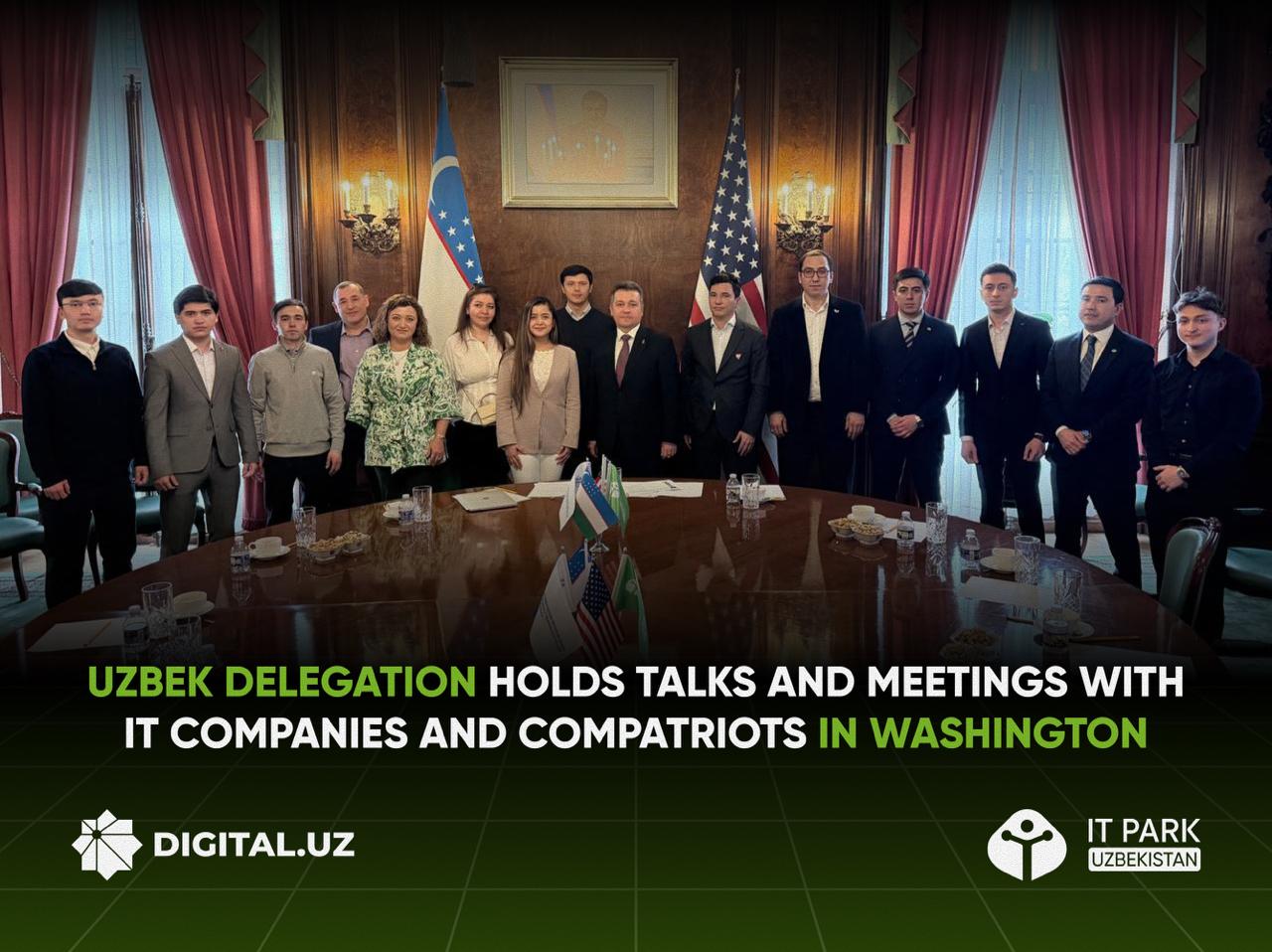
Uzbekistan’s Minister of Digital Technologies, Sherzod Shermatov, and CEO of IT Park Uzbekistan, Azamat Karamatov, held a series of meetings in Washington with international companies, startups, and Uzbek diaspora representatives. The discussions focused on developing the IT ecosystem, attracting investment, and boosting digital service exports.
Special attention was given to workforce development and strengthening tech skills.
During meetings with diaspora representatives and startup founders, participants discussed ways to bring international expertise and projects to Uzbekistan. They explored opportunities for launching joint initiatives, expanding outsourcing, and supporting local companies.
More than 20 representatives from international organizations and companies took part in the discussions, including Factour, Gourmet Concept Inc., World Turon Association, DOMiNO Ventures, The George Washington University, Harvard University, Georgetown University, Amazon Web Services (AWS), Oracle, World Bank Group, World Wildlife Fund (WWF), Mount Sinai Hospital, Balloon Stoll, among others.
A particular focus was placed on talent development. Discussions covered educational programs, internships, and online training involving international experts. Several cooperation formats were also proposed to engage the diaspora in developing the country’s IT ecosystem.
Among the initiatives presented was the Bonus System, which involves engaging technology experts as consultants to attract export-oriented international companies, along with a reward mechanism.
Another initiative, Uzbekistan Connect, aims to create a network of tech ambassadors to promote Uzbekistan’s potential in AI, outsourcing, venture investment, and the startup ecosystem.
Participants also discussed engaging students studying abroad in international IT events to expand professional networks and strengthen Uzbekistan’s presence on global platforms.
Talks with Ericsson, involving Vice President for Government Relations Jeffrey Marks, focused on developing telecommunications infrastructure and deploying next-generation technologies. Priority areas included enhancing network resilience and expanding internet coverage.
The parties also discussed ongoing telecom reforms in Uzbekistan, highlighting increased broadband coverage, the adoption of modern technologies, and the modernization of network infrastructure.
They exchanged views on key global trends, including smart cities, Internet of Things (IoT) ecosystems, and the use of artificial intelligence in network management — all of which align with Uzbekistan’s digital transformation strategy.
The development of data centers was also discussed, including “green” infrastructure projects aimed at strengthening the country’s position as a hub for international data and IT services.
During a meeting with IBM, attended by Vice President Emily Fontaine, the parties discussed enhancing Uzbekistan’s investment climate and expanding opportunities for both local and international collaboration.
They also addressed the use of modern “green” data centers being developed across the country, along with existing incentives and benefits in this sector.
Cooperation in artificial intelligence, cloud solutions, and other advanced technologies was discussed, with hybrid cloud and quantum technologies identified as priority areas.
Special attention was given to the creation of innovation labs, the launch of educational programs, and specialist certification. The possibility of hosting IBM infrastructure in new data centers and partially relocating projects from other regions was also considered.
The Uzbek side highlighted the country’s demographic potential, investments in IT education, and the growing number of multilingual specialists. Opportunities for data center development, including in Karakalpakstan, were also presented.
Discussions with Netsweeper focused on internet safety and content management solutions, with particular emphasis on protecting users, especially in educational environments.
The dialogue covered solutions to improve online safety in Uzbekistan, including protecting children and young people from harmful content.
In particular, participants discussed the phased introduction of content filtering systems for schools and higher education institutions, AI-based content classification, and early detection of harmful information flows.
Negotiations with the founder and CEO of GK Consultation, Grigory Mirzoev, focused on launching operations in Uzbekistan and developing cooperation in business services and transport technologies. The key topics included opening an office in the Jizzakh region and initiating activities under the Zero Risk program.
During the meeting, the parties discussed the company’s plans to enter the Uzbek market, including the development of consulting and SaaS solutions in the field of transport technologies. It was noted that in the first year of operation, the company plans to create around 50 jobs and generate service exports of up to $500,000.
The discussion also covered the formation of a local team with the involvement of Uzbek specialists and the launch of operational activities. Representatives of IT Park Uzbekistan and the Ministry of Digital Technologies expressed their readiness to support recruitment and project development.
ALIF UZ CORP is planning to expand its presence in Uzbekistan, as announced following a meeting with the company’s founder, Jamshiddin Fazliddinov. Key plans include opening a new office in Samarkand and expanding the team.
During the negotiations, the parties discussed the development of logistics services, including freight transportation, dispatch services, and fleet management. The expansion is expected to create up to 250 jobs and increase service exports by $3 million.
Special attention was given to the development of accounting and financial services with entry into international markets. The discussion also included training specialists, launching educational programs, and providing training aligned with international standards, including CPA certification.
A meeting with the Center for International Private Enterprise (CIPE) focused on developing the startup ecosystem and expanding into international markets.
The parties agreed to strengthen cooperation within the B5+1 platform, with a focus on the IT sector, e-commerce, and innovation. Discussions included attracting venture capital from the United States and supporting Uzbek startups.
The development of infrastructure was also addressed, including projects in artificial intelligence and data management.
Additionally, the participation of IT Park Uzbekistan in the B5+1 initiative as a coordinator for the IT sector was discussed, along with organizing the Uzbekistan Digital Roadshow in San Francisco with CIPE’s support.
Following the meetings, the parties agreed to continue dialogue and move toward more detailed project development. International companies expressed interest in launching infrastructure and educational initiatives in Uzbekistan.
These agreements are expected to lead to the opening of new offices and development centers, the expansion of data center infrastructure, and stronger cooperation in artificial intelligence and cloud technologies.
In the long term, these efforts are set to strengthen Uzbekistan’s position as a regional IT hub and boost digital service exports.